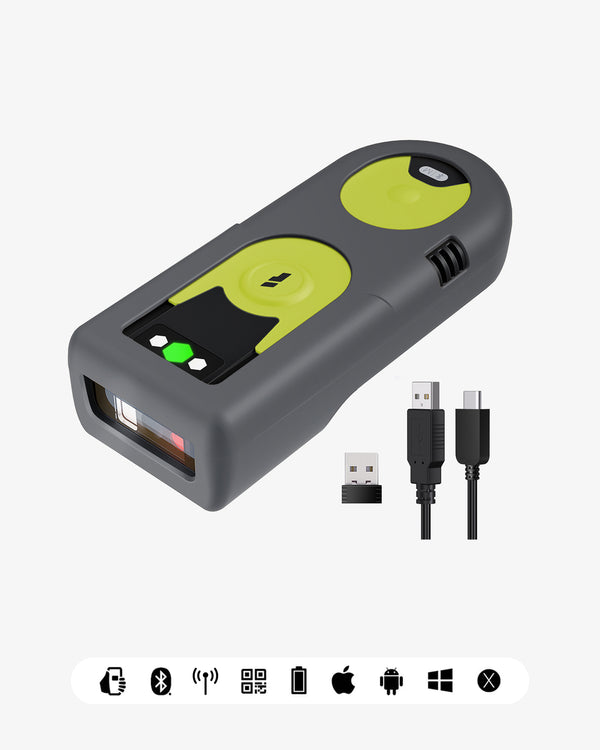
Inateck industrial Barcode Scanner BCST-75 vs BCST-75S: Real Customer Reviews, Features & FAQ Guide
When choosing an industrial barcode scanner for a warehouse, logistics hub, or manufacturing floor, the Inateck BCST-75 series is one of the most talked-about options among business users.
Most common questions:
-
What’s the actual difference between the BCST-75 and BCST-75S?
-
Will it work with Shopify or my POS system?
-
Can it scan damaged or blurry barcodes?
-
Is the Bluetooth connection reliable?
-
Is it rugged enough for a warehouse environment?
-
What does the AI feature actually do?
This guide breaks down customer feedback, product highlights, and FAQs.
Honest customer concerns
1. Initial setup requires reading the manual
Advanced setup — like Bluetooth pairing, barcode formatting, or changing transmission modes — requires scanning barcodes from the manual.
It’s not complicated, but first-time users should expect a short learning curve.
2. Occasional reconnection needed in noisy environments
A small number of users in areas with heavy wireless interference (e.g., huge warehouses with lots of RF equipment) reported occasional reconnection needs.
This is standard across wireless scanners in large industrial spaces — not unique to Inateck.
Frequently Asked Questions (FAQ)
Q1: Will it work with Shopify?
Yes. It works with Shopify, Square, QuickBooks, and most POS systems because it acts as a standard HID keyboard input device. Just pair or plug it in — it types barcode data like a keyboard.
Q2: Can it scan barcodes from a phone screen?
Yes. It handles mobile payment codes, QR codes on screens, digital tickets, PDF417, and Data Matrix codes without issues.
Q3: Does it support continuous scanning?
Yes. Three modes available:
-
Manual trigger (pull trigger for each scan)
-
Auto-sensing (wave a barcode in front)
-
Continuous scanning (keeps scanning while barcodes are present)
Great for high-volume warehouse workflows.
Q4: Can I connect it to my phone or tablet?
Yes. Bluetooth works with iPhone, iPad, Android phones, and Android tablets. A solid option for mobile inventory apps.
Q5: How long does the battery last?
The 2600mAh battery delivers up to 180,000 scans on a full charge, with 180 days of standby time.
-
BCST-75S includes a charging cradle — drop it in during breaks to keep it charged.
-
BCST-75 requires USB charging unless you buy the base separately.
Q6: Is it tough enough for a warehouse?
Absolutely. Designed for warehouses, logistics, manufacturing, and distribution centers.
-
IP67 = dustproof + splash/rain resistant
-
3.6m (12ft) drop resistance — survives falls from loading docks or ladders.
Q7: What do the AI features on the BCST-75S actually do?
Two main things:
-
Smarter decoding – reads blurry, damaged, dirty, or low-contrast barcodes that would trip up standard scanners
-
App-based setup – the Inateck app uses AI to simplify configuration and data processing
For most warehouse users, the real value is decoding problematic labels.
Q8: Can I buy the charging base separately for the BCST-75?
Yes. Sold separately as model BCST-75S-Base for $29.99.
Compatible with both BCST-75 and BCST-61 models. Start with BCST-75 and add the cradle later if needed.
BCST-75 vs BCST-75S: Side-by-Side Comparison
| Feature | BCST-75 | BCST-75S |
|---|---|---|
| IP67 Waterproof & Dustproof | ✅ | ✅ |
| 3.6m (12ft) Drop Resistance | ✅ | ✅ |
| 1D / 2D / QR / PDF417 / Data Matrix Support | ✅ | ✅ |
| Bluetooth / 2.4G / USB Connection | ✅ | ✅ |
| 2600mAh Battery | ✅ | ✅ |
| Charging Base Included | ❌ | ✅ |
| AI-Assisted Decoding | ❌ | ✅ |
| AI Data Processing | ❌ | ✅ |
| App Configuration | ✅ | ✅ |
Final verdict
Choose the BCST-75 series if you need:
-
Rugged, job-site durability
-
Long battery life for full shifts
-
Multiple connection options
-
Reliable performance on all barcode types
| Your needs | Recommended model |
|---|---|
| Standard warehouse scanning, inventory, POS – you don’t mind USB charging | BCST-75 |
| You want the charging cradle + AI help for tricky barcodes |
One more thing worth considering
The BCST-75S’s charging base isn’t just about convenience. In a busy warehouse, a dedicated “home” for the scanner means fewer lost devices and a battery that’s always topped up. For multi-shift operations, that alone can justify the upgrade.
For warehouse, logistics, and industrial users, the biggest advantages remain the same: durability, stability, compatibility, and low deployment complexity.